MCP vs A2A: A Practical Guide to AI Agent Protocols
Compare Model Context Protocol and Agent2Agent: what each protocol connects, how their architectures differ, where they can work together, and how to choose safely.
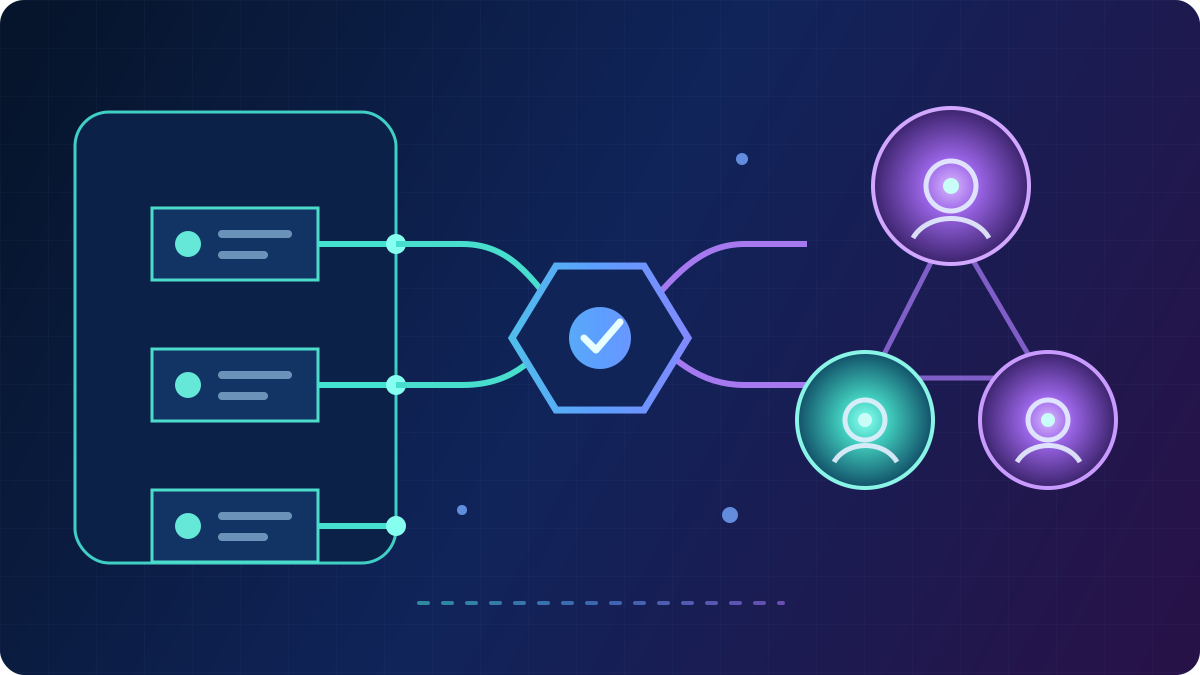
Model Context Protocol (MCP) and Agent2Agent Protocol (A2A) address different interoperability layers in AI systems. MCP connects an AI application to tools, resources, and prompt templates. A2A allows independent agents to discover capabilities, exchange messages, and coordinate tasks.
They are not direct substitutes. A coordinating agent could use A2A to delegate work to another agent, while either agent uses MCP to access a database or business tool. Many applications need one protocol, neither, or a limited combination—not a protocol stack by default.
For MCP fundamentals and the current specification, read Model Context Protocol explained. If agent concepts are new, start with what is agentic AI and browse AI agent tools.
The shortest useful distinction
Ask what is on the other side of the connection:
- With MCP, an AI host connects to a server exposing bounded capabilities or context.
- With A2A, an agent client communicates with another agent that can manage and perform a task.
An MCP tool generally has a defined schema and returns a result. An A2A agent may reason independently, ask for more information, provide progress, produce artifacts, and complete or fail a longer-running task.
MCP and A2A compared
| Dimension | MCP | A2A |
|---|---|---|
| Primary purpose | Connect AI applications to tools and data | Enable agent-to-agent collaboration |
| Main counterpart | MCP server | Remote agent |
| Capability description | Tools, resources, and prompts | Agent Card skills and interfaces |
| Typical interaction | Discover and invoke/read | Send messages and manage tasks |
| Autonomy expected remotely | Not required | Usually expected |
| Long-running work | Application-specific patterns | Task lifecycle is a core concern |
| User experience | Usually owned by the MCP host | May span collaborating agents |
| Common example | IDE reads repository data or invokes an issue tool | Travel agent delegates to a booking agent |
| Security focus | Server trust, tool scope, resource access | Agent identity, delegation, task data, artifacts |
Both rely on application-level policy. A protocol can standardize communication, but it does not decide whether a server is trustworthy, an agent is competent, or a user is authorized.
How MCP works
An MCP host creates clients that communicate with MCP servers. A server can expose:
- Tools for actions or computations;
- Resources for readable context;
- Prompts as reusable templates.
The host controls the user interface, model access, permission policy, and presentation of results. MCP uses JSON-RPC and supports deployments including local processes and remote HTTP services. Compatibility depends on the protocol revision and implementation.
MCP helps AI applications reuse integrations and discover capabilities. For one stable connection, a direct SDK may be simpler.
How A2A works
A2A defines communication between a client agent and a remote agent. A discoverable Agent Card describes identity, endpoint, capabilities, skills, and supported interaction modes. Messages contain parts such as text, files, or structured data. A task can move through lifecycle states and return artifacts or status updates.
The remote agent can remain opaque and independently operated. The client needs a supported skill, communication contract, and task interface—not access to internal tools or memory.
A2A does not make delegation correct. The client still needs to validate identity, scope the task, protect data, handle timeouts, and assess returned artifacts.
How they can work together
Consider a procurement assistant:
- The user asks it to compare approved suppliers and prepare an order.
- The assistant uses MCP resources to read internal purchasing policy.
- It uses an MCP tool to query the approved-vendor database.
- It delegates a shipping-availability task to a logistics agent through A2A.
- The logistics agent may use its own MCP servers or direct APIs internally.
- The procurement assistant validates the returned artifact.
- A deterministic policy layer checks limits and requests user approval before any purchase.
MCP handles access to capabilities within each agent’s environment; A2A handles delegation across agent boundaries. This layering is conceptual, not mandatory. Direct APIs can remain preferable for performance-critical or narrow integrations.
A practical selection framework
Choose MCP when
- an AI host needs reusable access to tools or context;
- capabilities should be discovered through a shared interface;
- you control a business service and want compatible hosts to use it;
- the operation is naturally a bounded read or tool call;
- the host should retain orchestration and user consent.
Choose A2A when
- an independent remote agent owns a specialized workflow;
- work may be long-running or require intermediate updates;
- the remote implementation should remain opaque;
- multiple organizations or systems need to delegate tasks;
- outputs include artifacts, clarification requests, or lifecycle state.
Choose direct integration when
- only one client and one stable service are involved;
- existing API contracts already meet the requirement;
- latency, throughput, or minimal dependencies dominate;
- protocol discovery adds little value;
- the remote system is a deterministic service, not an agent.
Use both when
Independent agents genuinely need to collaborate and at least one agent also benefits from reusable tool or data access. Introduce the protocols separately, measure each boundary, and avoid translating every internal function into a network capability.
Architecture and security questions
Before choosing, answer:
- Who operates each endpoint? Same team, another department, a vendor, or unknown third party?
- What authority crosses the boundary? Read-only data, writes, money movement, messages, or code execution?
- Whose identity applies? The user, host, service account, or delegated agent?
- What data is disclosed? Full conversation, selected fields, files, credentials, or retrieved documents?
- How is consent represented? Does the user see the actual action, destination, and data?
- How are retries handled? Can a repeated request duplicate a purchase or message?
- What is auditable? Identity, protocol version, request, approval, task state, result, and errors?
- How does failure contain itself? Timeouts, cancellation, quotas, revocation, and rollback?
Remote discovery metadata is untrusted input. Verify endpoint ownership and use authenticated channels. Do not grant privileges merely because a tool or skill description says they are needed.
Implementation checklist
- The use case requires interoperability rather than a simple direct API.
- Protocol and SDK revisions are pinned and tested together.
- Endpoint identity and discovery metadata are verified.
- Credentials are least-privilege and separated by server or agent.
- User and tenant authorization is enforced on every operation.
- Inputs, outputs, files, URLs, and artifacts are validated.
- Sensitive data is minimized before crossing boundaries.
- Consequential actions use clear previews and explicit approval.
- Write operations are idempotent or protected from duplicate retries.
- Timeouts, cancellations, quotas, and revocation are implemented.
- Logs preserve task and tool lineage without unnecessary secrets.
- Prompt injection and malicious peer behavior are tested.
The prompt injection defense guide covers controls for untrusted tool results, retrieved documents, and agent messages.
Operational limitations
Protocol compatibility does not guarantee shared semantics. Implementations may disagree about task meaning, recovery, authentication, or artifact schemas.
Discovery increases supply-chain exposure. A malicious endpoint may advertise convincing capabilities or return hostile content. Keep delegation depth and authority bounded.
Protocol standards are evolving. Confirm the current official specification and SDK behavior rather than depending on examples written for older versions. Isolate adapters so protocol changes do not spread through core business logic.
FAQ
Is A2A a replacement for MCP?
No. A2A focuses on communication with independent agents; MCP focuses on connecting AI applications to tools and context. Their use cases can coexist.
Is every MCP server an agent?
No. An MCP server may expose deterministic resources or tools without planning, autonomy, or a task lifecycle.
Do these protocols provide authentication automatically?
They define relevant mechanisms and integration points, but secure identity, authorization, credential handling, and deployment remain implementation responsibilities.
Should internal microservices use MCP or A2A?
Usually not by default. Existing typed APIs and queues may be clearer. Add an agent protocol when model-facing discovery or cross-agent delegation provides concrete value.
Bottom line
Use MCP to give an AI application controlled access to tools and data. Use A2A when one independent agent must delegate a task to another. Combine them only when both boundaries exist, and keep authorization, validation, consent, and audit controls outside model judgment. Continue with AI agent guides, agentic RAG explained, and AI platform comparisons.