Agentic RAG Explained: When Retrieval Needs an Agent
Understand how agentic RAG adds planning, iterative retrieval, and tools to a retrieval pipeline—and when the extra complexity is justified.
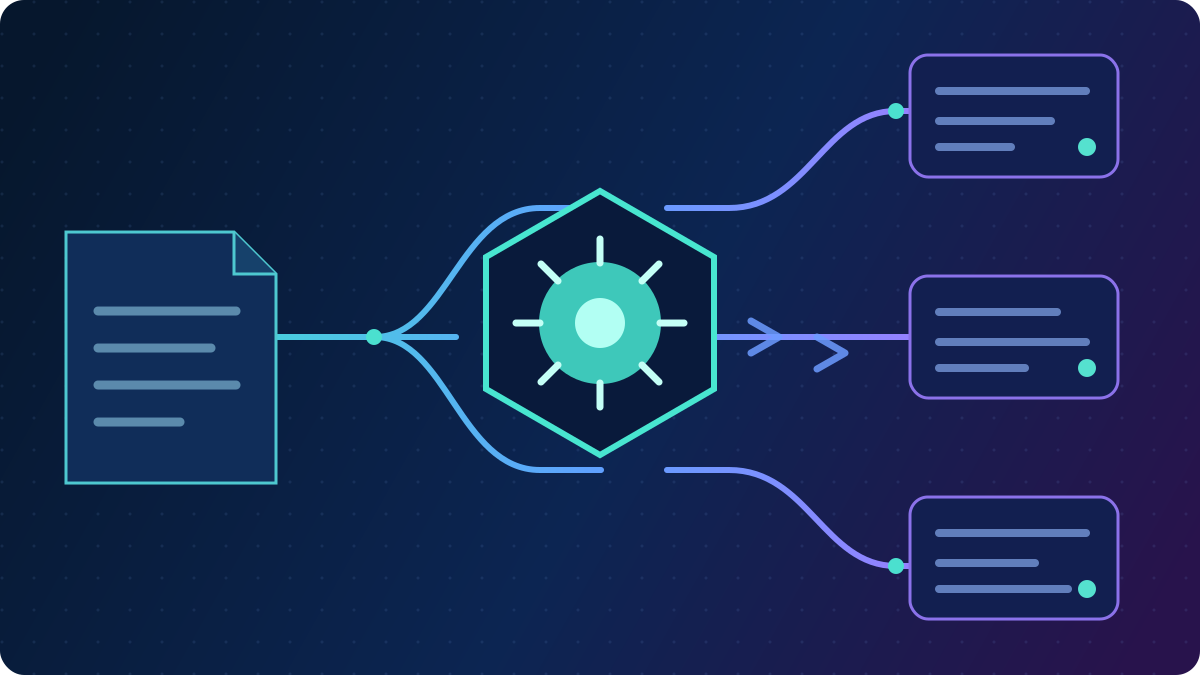
Agentic retrieval-augmented generation (agentic RAG) uses an AI agent to decide how, when, and where to retrieve information instead of running one fixed search before every answer. The agent may rewrite a query, choose among sources, inspect results, call a structured tool, retrieve again, or stop when evidence is sufficient.
This flexibility helps with multi-part research and heterogeneous data. It also adds latency, cost, nondeterminism, security exposure, and new failure modes. Many applications need a better conventional RAG pipeline—not an agent.
Start with RAG explained if chunking, embeddings, reranking, and grounded generation are new. For broader context, read how agentic AI works and browse AI agent tools.
Conventional RAG versus agentic RAG
A conventional RAG application usually follows a predetermined path:
- Transform the user query.
- Search one or more indexes.
- Rerank or filter results.
- Place selected passages in the model context.
- Generate an answer with citations.
An agentic system turns some of those fixed decisions into model-selected actions.
| Capability | Conventional RAG | Agentic RAG |
|---|---|---|
| Search count | Usually fixed | Iterative, with explicit limits |
| Source selection | Configured by application | Agent may route among allowed sources |
| Query strategy | Predetermined rewrite or hybrid search | Adapted after inspecting evidence |
| Structured data | Separate fixed pipeline | Agent may call databases or APIs |
| Decomposition | Limited or rule-based | Agent can split multi-part questions |
| Predictability | Higher | Lower |
| Latency and cost | Easier to bound | Variable unless capped |
| Audit complexity | Moderate | Higher because trajectories vary |
“Agentic” does not imply autonomy without controls. The application should still restrict sources, tools, permissions, iterations, time, and output behavior.
When an agent improves retrieval
Questions require decomposition
A request such as “Compare this quarter’s support incidents with the release history and explain likely causes” may require multiple searches across different systems. An agent can split the request into subquestions, collect evidence, and reconcile dates.
Use deterministic workflows when decomposition is stable. If every request always needs the same three queries, ordinary orchestration is easier to test.
Sources have different interfaces
An agent can route a question to document search, SQL, a graph, or an API. Each interface should expose a narrow, validated schema.
Retrieval needs correction
The first query may return ambiguous names, stale material, or no evidence. An agent can inspect metadata, refine terms, widen a date range, or ask the user a clarifying question. This works best when the system can measure evidence quality rather than relying on vague self-confidence.
The task is exploratory
Research, incident investigation, and due diligence may require following leads that cannot be enumerated in advance. Iterative retrieval can discover relevant entities and source relationships. Human review remains important when conclusions have legal, financial, security, or health consequences.
When conventional RAG is better
Use a fixed pipeline when questions are narrow, low latency matters, or compliance requires a predictable trace. Common lookups often benefit more from improved metadata, hybrid search, and reranking.
Do not add an agent to compensate for:
- missing or poorly governed source documents;
- broken access-control filters;
- weak chunking or metadata;
- an index that is stale;
- no evaluation set;
- prompts that do not require citations;
- unclear product requirements.
Agentic loops multiply the consequences of these defects.
A bounded agentic RAG architecture
1. Intake and policy
Authenticate the user, classify the request, determine allowed corpora and tools, and identify whether the task requires approval or should be refused. Apply permissions before retrieval.
2. Planner or router
The model produces a small structured plan or chooses the next action from an allowlist. Keep plans short and revisable; lengthy hidden plans add tokens without guaranteeing quality.
3. Retrieval tools
Expose purpose-specific operations such as search_policies, query_incident_metrics, or get_release. Validate filters and map user identity to server-side permissions. Return compact results with source IDs, timestamps, and trust metadata.
4. Evidence state
Maintain structured claims, citations, unresolved questions, and conflicts. Deduplicate sources and cap stored content.
5. Stop and answer policy
Stop when required claims have adequate evidence, the user must clarify, a limit is reached, or sources conflict. The final response should distinguish evidence, inference, and uncertainty and link claims to sources.
6. Observability
Capture the query, selected tools, arguments, source identifiers, policy decisions, durations, errors, and final citations. Redact sensitive values and follow retention policy. Traces are essential for debugging variable trajectories.
A practical implementation process
- Build a strong fixed baseline. Implement permissions, hybrid retrieval, reranking, citations, and abstention first.
- Collect failure cases. Find questions the baseline misses because they need decomposition, source routing, or iterative correction.
- Add one bounded decision. Start with a router or one optional second search instead of a general autonomous loop.
- Define tool contracts. Use strict schemas, least-privilege credentials, timeouts, result limits, and deterministic validation.
- Create explicit budgets. Cap iterations, tokens, sources, wall time, and external calls. Define behavior at each limit.
- Evaluate end states and traces. Check answer support, retrieval quality, forbidden actions, repeated calls, latency, and recovery.
- Pilot with escalation. Let users inspect citations and send ambiguous or high-impact cases to a person.
- Expand only from measured gains. Add planning or tools when a documented failure category justifies them.
Evaluation criteria
Compare the agentic system against the fixed baseline on the same representative dataset.
- Task success: Did it answer all required parts?
- Evidence recall: Did it find the authoritative sources?
- Citation correctness: Does each source support its claim?
- Abstention: Does it stop when evidence is absent or unauthorized?
- Efficiency: How many searches, tool calls, and tokens were needed?
- Latency: What are median and tail completion times?
- Safety: Were access, tool, and data-flow policies respected?
- Stability: How often do repeated runs reach acceptable outcomes?
For a complete methodology, see AI evals explained. Track failure severity, not only average answer scores.
Security and reliability checklist
- User and tenant permissions apply before every retrieval.
- Each tool has a narrow purpose and validated schema.
- Retrieved content is treated as untrusted data.
- Credentials are scoped per service and absent from prompts.
- Network destinations and database operations are allowlisted.
- Calls, iterations, tokens, time, and result sizes are capped.
- Writes and consequential actions require separate authorization.
- Duplicate or retryable operations are idempotent.
- Evidence keeps source, date, and trust metadata.
- Final claims cite supporting evidence or state uncertainty.
- Traces support replay and incident investigation.
Indirect prompt injection is a particular concern because retrieved pages can contain hostile instructions. Follow the prompt injection defense guide before connecting agents to private data or tools.
Limitations
An agent can formulate a sophisticated search and still retrieve incomplete, poisoned, or outdated material. Self-reflection is not an independent fact check. Multiple agents may increase diversity, but they can share the same model biases and produce additional coordination failures.
Variable loops complicate capacity planning and testing. Longer traces can degrade attention, while repeated retrieval exposes more untrusted content. Limits must balance premature stopping against runaway work.
FAQ
Is agentic RAG the same as a RAG agent?
The terms are used inconsistently. Both generally describe an agent controlling retrieval decisions. Define the actual capabilities, limits, and tools instead of relying on the label.
Does agentic RAG need a vector database?
No. It can use keyword search, SQL, graph queries, APIs, files, or combinations. Choose each retrieval method for the underlying data.
Should the agent decide when evidence is sufficient?
It can propose that decision, but explicit requirements, source rules, confidence signals, and hard limits should constrain it. High-impact conclusions may require human review.
Bottom line
Agentic RAG is justified when representative questions require dynamic decomposition, source routing, or evidence-driven retries that a fixed pipeline cannot handle. Begin with a secure conventional RAG baseline, add the smallest useful decision loop, cap every resource, and demand measured improvements in task success. Continue with AI agent guides, MCP explained, and AI platform comparisons.