RAG Explained: A Practical Retrieval-Augmented Generation Guide
Learn how retrieval-augmented generation works, when to use it, how to evaluate it, and where RAG systems commonly fail.
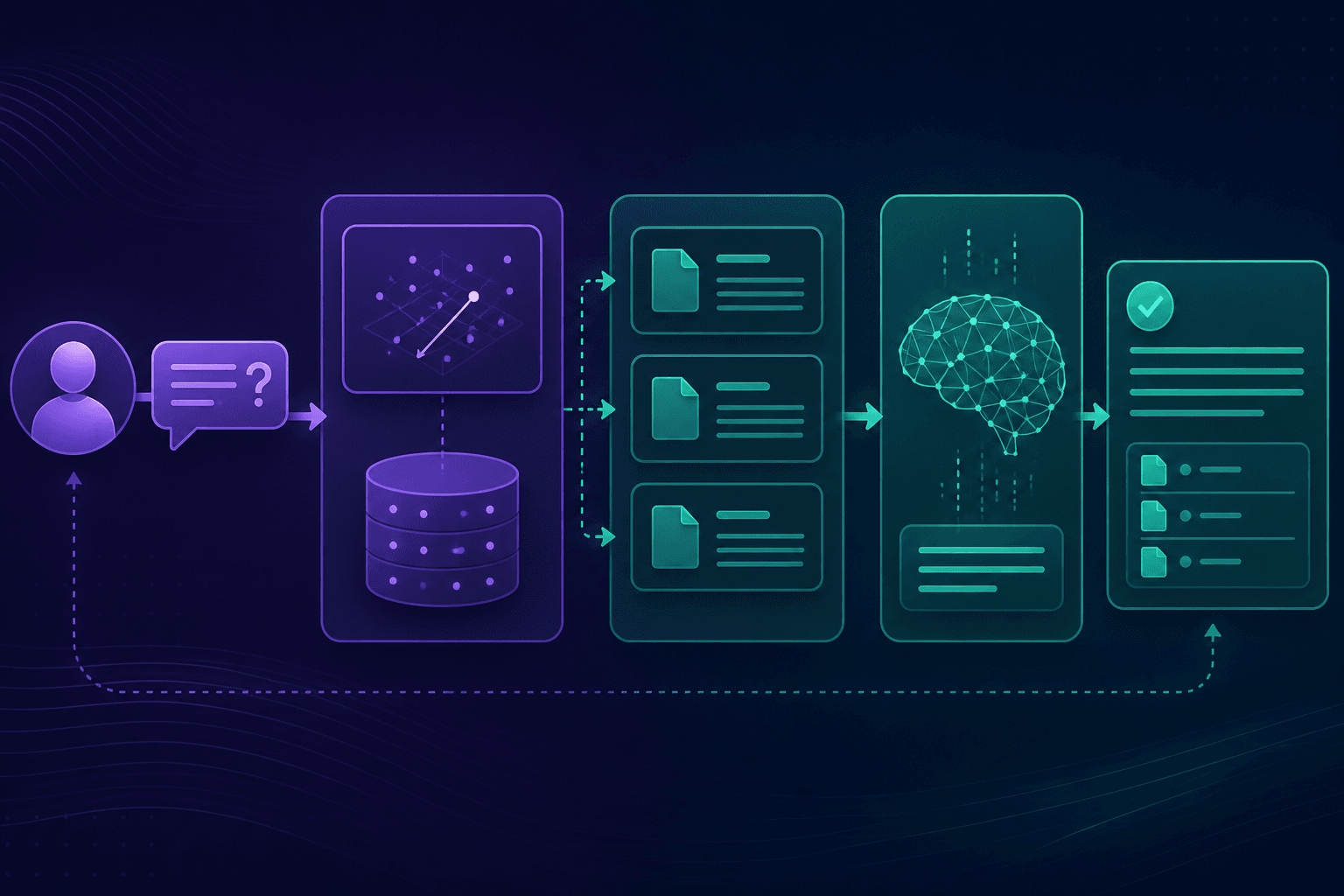
Retrieval-augmented generation (RAG) is a pattern that gives a language model relevant information at request time. Instead of relying only on knowledge encoded during training, an application searches an approved collection—documents, product records, policies, or other data—and includes useful results in the model’s context.
RAG can make answers more current, domain-specific, and traceable. It does not make a model automatically factual. The system can retrieve the wrong passage, omit an important document, misread a source, or generate a claim that the source never made.
This guide explains the architecture and an implementation path without assuming one vendor. For related choices, see prompting vs RAG vs fine-tuning, local LLM vs cloud AI, and AI development tools.
RAG in one example
Imagine an employee asks, “How many days do I have to submit an expense?” A general model may guess based on common policies. A RAG application instead:
- Converts the question into a search representation.
- Searches the company’s approved policy collection.
- Retrieves the relevant expense-policy passage.
- Sends the question and passage to a language model.
- Produces an answer with a link or citation to the policy.
If the policy is missing or ambiguous, the safest answer may be “I could not verify this” rather than a plausible guess.
The core pipeline
| Stage | What happens | Common failure |
|---|---|---|
| Ingestion | Load documents and metadata | Old, duplicate, or unauthorized content enters the index |
| Parsing | Extract text and structure | Tables, scans, or headings are lost |
| Chunking | Divide content into retrievable units | Chunks lose context or become too broad |
| Indexing | Store lexical and/or vector representations | Important metadata is omitted |
| Retrieval | Find candidates for a query | Relevant wording does not match the query |
| Reranking | Reorder candidates by likely relevance | A reranker favors similar but non-answering text |
| Generation | Compose an answer from context | The model adds unsupported details |
| Evaluation | Measure retrieval and answer behavior | Teams grade fluency instead of correctness |
Production systems often add query rewriting, hybrid search, access-control filters, caching, citation mapping, and abstention rules.
Embeddings, vector search, and hybrid retrieval
An embedding is a numeric representation intended to place semantically related text near each other. Vector search compares the query representation with stored document vectors. This can find conceptually similar language even when exact terms differ.
Lexical search remains valuable for exact names, error codes, identifiers, and uncommon phrases. Hybrid search combines lexical and vector results, often followed by a reranker. Test retrieval against your own questions.
Chunking without losing meaning
Chunking affects both retrieval and generation. Tiny chunks may omit qualifiers; huge chunks can bury the answer and consume context. Start with document structure rather than an arbitrary character count:
- Preserve headings and parent section titles.
- Keep lists and table rows with necessary labels.
- Avoid splitting a sentence or procedure midway.
- Attach metadata such as source, date, owner, version, and permissions.
- Consider overlap only where it genuinely preserves continuity.
RAG versus fine-tuning and long context
| Approach | Best suited to | Key tradeoff |
|---|---|---|
| Prompting | Instructions and a small amount of supplied context | Manual context does not scale |
| RAG | Dynamic or private factual knowledge with source access | Requires a reliable retrieval pipeline |
| Fine-tuning | Behavior, style, format, or repeated task patterns | Poor mechanism for frequently changing facts |
| Long-context input | A bounded set of documents that fit in one request | Cost, latency, and “needle” retrieval can still matter |
These approaches can be combined. A fine-tuned model can still use RAG, and a RAG system can pass several full documents when context allows. Choose based on requirements rather than treating RAG as mandatory.
A practical implementation plan
1. Define the task and refusal boundary
Write representative questions, expected answers, approved sources, and cases where the system must abstain. Decide whether the application summarizes, answers questions, recommends actions, or retrieves passages.
2. Build a small trustworthy corpus
Start with a narrow collection that has clear owners and versions. Remove duplicates, record provenance, and define a deletion process. More documents can reduce quality if they add stale or conflicting content.
3. Create a baseline retriever
Implement simple lexical search first or alongside vector search. Return passages without generation and ask domain experts whether the needed evidence appears. This isolates retrieval problems from model problems.
4. Add generation with grounded instructions
Tell the model to answer only from supplied context, cite sources, distinguish conflicts, and abstain when evidence is insufficient. These instructions reduce risk but cannot enforce truth on their own.
5. Evaluate end to end
Use a held-out set of realistic questions. Include typos, ambiguous wording, outdated assumptions, permission boundaries, and questions with no answer. Review both retrieved evidence and final response.
Evaluation checklist
- Retrieval recall: Does the candidate set contain the required evidence?
- Retrieval precision: Are retrieved passages actually useful?
- Faithfulness: Does each answer claim follow from provided context?
- Answer relevance: Does the response address the user’s question?
- Citation correctness: Does the cited passage support the claim?
- Abstention: Does the system decline when evidence is missing?
- Freshness: Are updated documents indexed promptly?
- Authorization: Can users retrieve only content they may access?
- Latency and cost: Does the complete workflow meet operational needs?
Automated model-based graders can accelerate testing but should be calibrated against human judgments. Do not present one aggregate score as proof of reliability.
Security and operational limitations
RAG introduces a new data path. Enforce authorization during retrieval, not only in the user interface. Encrypt sensitive data, minimize logs, and establish retention and deletion controls.
Retrieved documents can contain prompt injection such as instructions telling the model to reveal data or ignore policy. Treat retrieved text as untrusted input. Separate system instructions from document content, restrict available tools, validate outputs, and test adversarial documents.
Other limitations include index lag, parser failures, conflicting sources, embedding drift, and cost from multi-stage retrieval.
FAQ
Does RAG eliminate hallucinations?
No. It can provide evidence, but retrieval and generation can both fail. Citations and abstention improve reviewability, not certainty.
Do I need a vector database?
Not always. A relational database, search engine, or managed retrieval service may be enough. Start with the simplest system that meets scale and relevance needs.
Can RAG search private data safely?
Yes, if identity and authorization filters are correctly enforced throughout ingestion and retrieval. “Private index” alone is not an access-control design.
Bottom line
RAG is most useful when answers depend on changing, proprietary, or source-backed knowledge. Begin with a narrow corpus and a retrieval baseline, then add generation, citations, abstention, security controls, and continuous evaluation. Browse developer guides, compare local and API models, or review AI coding assistants for implementation support.