What Is Agentic AI? How AI Agents Work
Learn what agentic AI means, how AI agents plan and use tools, where they help, and which risks teams should manage before deployment.
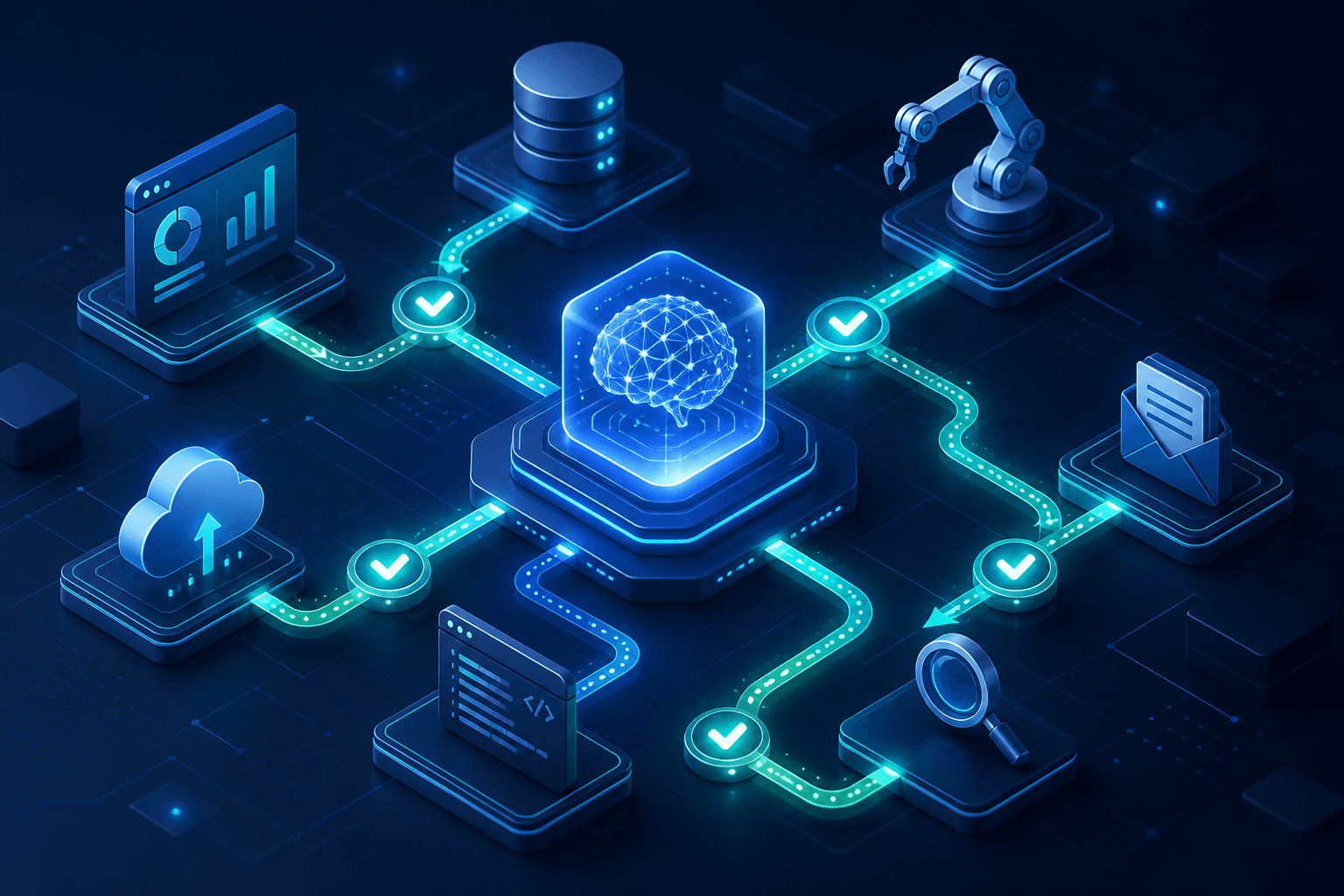
Agentic AI describes software that can pursue a goal through multiple steps, choose actions, use tools, inspect results, and adjust its approach. A chatbot mainly returns an answer. An AI agent may search a knowledge base, draft a response, update a ticket, and ask for approval before sending it.
That distinction matters because autonomy changes both usefulness and risk. An inaccurate paragraph is inconvenient; an inaccurate action in a billing or customer system can be costly. This guide explains how AI agents work, what they are good at, and how to introduce them responsibly.
For adjacent concepts, browse the AI tools directory, AI guides, and model comparisons.
Agentic AI in plain English
An agent combines a language model with instructions, tools, state, and a control loop. The model does not become independently intelligent. It operates inside an application that decides what context it receives, which actions are available, and when execution must stop.
A typical loop looks like this:
- Receive a goal and relevant context.
- Decide on the next step.
- Call an allowed tool, such as search or a CRM API.
- Observe the tool result.
- Continue, revise, ask for approval, or finish.
The “agentic” part is the repeated selection of actions toward an outcome. Some systems follow a fixed workflow with one flexible step; others let a model select among many tools. More freedom is not automatically better.
Chatbot, workflow, copilot, or agent?
| System | Typical behavior | Best fit | Main limitation |
|---|---|---|---|
| Chatbot | Answers one prompt at a time | Questions, drafting, summarizing | Usually does not act |
| Automation workflow | Runs predefined rules | Stable, repetitive processes | Handles surprises poorly |
| Copilot | Suggests work to a person | High-judgment tasks | Requires human attention |
| AI agent | Chooses and executes multiple steps | Variable but bounded processes | Can compound mistakes |
These categories overlap. A customer-service copilot can become an agent when it gains permission to issue refunds. Judge the system by its actual permissions and behavior, not its product label.
The building blocks of an AI agent
1. A model
The model interprets the goal, selects actions, and generates outputs. Model quality matters, but a stronger model cannot compensate for unsafe permissions or unreliable data.
2. Instructions and policies
Instructions define the role, success criteria, prohibited actions, and escalation rules. Policies should be enforceable in code where possible. A prompt saying “never refund over $100” is weaker than an API that rejects such requests.
3. Tools
Tools connect the agent to search, databases, browsers, email, code execution, or business applications. Tool descriptions and input schemas help the model use them correctly. Standards such as Model Context Protocol can simplify integration; see Model Context Protocol explained.
4. State and memory
Short-term state tracks the current task. Longer-term memory may store preferences or prior outcomes. Retention should be deliberate: unnecessary memory increases privacy, security, and data-quality risks.
5. Orchestration
The orchestration layer runs the loop, applies limits, records traces, handles retries, and routes approvals. Some designs use one agent; others delegate to specialists. Multi-agent designs add coordination cost and should solve a demonstrated problem.
6. Evaluation and oversight
Production agents need test cases, audit logs, permission controls, and measurable outcomes. Human review is especially important for money movement, legal commitments, health, employment, and irreversible changes.
A practical example
Consider an agent that prepares a weekly sales brief:
- It queries approved CRM fields.
- It calculates changes using deterministic code.
- It retrieves account notes.
- It drafts a summary with links to source records.
- It flags missing or contradictory data.
- A manager reviews the draft before distribution.
The model explains and organizes; code performs arithmetic; permissions limit data access; a person controls publication. This is more reliable than asking a model to “analyze sales” with broad access and no review.
Where AI agents work well
Good candidates have a clear goal, digital inputs, reversible actions, and an objective way to check success. Examples include:
- Triage and draft responses for support tickets.
- Gather approved sources for a research brief.
- Classify documents and route exceptions.
- Prepare CRM updates for human approval.
- Run tests, summarize failures, and suggest code changes.
- Reconcile routine records while flagging mismatches.
For implementation ideas, see AI automation workflows for small business and best AI agents for business.
Limitations and risks
Agents can misunderstand goals, fabricate facts, select the wrong tool, or continue after a faulty observation. Tool output and web pages may contain prompt-injection attempts. Long tasks can drift, repeat actions, consume unexpected resources, or expose sensitive data.
They also face ordinary software failures: expired credentials, API changes, timeouts, duplicate events, and bad records. “Autonomous” does not mean self-verifying.
Reduce risk with least-privilege access, sandboxing, spending and step limits, idempotent actions, structured outputs, source citations, approval gates, and an immediate stop control. Never treat an agent’s fluent explanation as proof that an action was correct.
Readiness checklist
Before launching an agent, confirm:
- The goal and completion condition are measurable.
- A simpler rule-based workflow was considered.
- Tools expose only necessary data and actions.
- High-impact or irreversible actions require approval.
- Inputs and tool results are treated as untrusted.
- Test cases include failures and adversarial content.
- Logs show prompts, tool calls, approvals, and outcomes.
- Cost, time, and retry limits are enforced.
- A named owner can pause and investigate the system.
Start in read-only mode, then add narrow write permissions after evaluation. Compare error rates, time saved, escalations, and user corrections—not just polished demos.
FAQ
Is agentic AI the same as generative AI?
No. Generative AI creates content. Agentic systems use generative models inside a loop that can select tools and actions. Most current agents rely on generative AI, but the terms describe different capabilities.
Do AI agents think like people?
No. “Planning” is useful shorthand for model-guided action selection. It does not establish human-like understanding, intent, or consciousness.
Are fully autonomous agents ready for business use?
Some bounded tasks are ready with controls and monitoring. Broad, unsupervised operation across sensitive systems remains risky. Reliability depends on the task, integrations, permissions, and evaluation—not the label.
Should a team use one agent or several?
Begin with one focused agent. Add specialists only when separate instructions, permissions, or evaluation criteria clearly improve the system.